
Why Offa of Mercia replaced the old sceatta with a bigger silver penny in the 760s, what his coinage owed to Frankish reform, and why the most famous English coin of the century is a gold piece that copies an Arabic dinar.
The coin that England used for the next thousand years begins here. In the 760s, the kings of Kent and Mercia replaced the sceatta, a small thick silver coin, with a broad penny modelled on a Frankish design. Within a generation the penny had spread across the Anglo-Saxon kingdoms, and it stayed in service, through countless redesigns, until decimalisation in 1971. Offa of Mercia, who ruled from 757 to 796, did not invent it alone, but his coinage is where the new standard becomes confident, and it produced some of the most remarkable coins ever struck in England.
The sceatta problem
Sceattas were the small, often debased silver pennies of the early eighth century, and by its middle decades the series was fraying. In Francia, Pepin the Short swept the equivalents away with his denier reform of about 755, issuing broader, better-silver coins. D. M. Metcalf's study of the transition in the British Numismatic Journal (2009) shows Frankish coins, including pieces struck in Pepin's name, circulating in England and setting the template; Marion Archibald had already documented this Frankish pressure in the same journal in 2004. In weight terms the difference was stark: recent weight studies summarise the new Frankish denier as carrying more than twice the bullion of a half-silver sceat, and Offa's early broad pennies as carrying several times as much again.
The first broad pennies in England appear in Kent in the mid-760s, in the name of King Heaberht, and Offa adopted the format for Mercia shortly afterwards. The logic of the reform is straightforward: a bigger, purer coin is easier for a state to control and easier for merchants to trust, and the king who issues it collects the seigniorage. What makes Offa's version interesting is how visibly his moneyers were learning on the job.
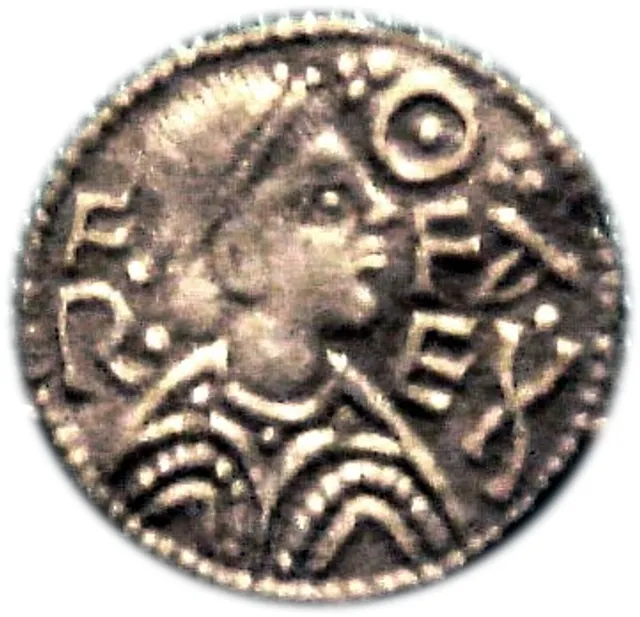
Roman letters nobody could read
Offa's pennies borrow the look of Roman coins, including the Roman alphabet, but many legends are garbled in ways that suggest the die-cutters were copying letterforms rather than writing words. Legends like PETRX instead of PETRVS appear on coins of the period, and the same moneyers' names, real Anglo-Saxon men such as Eoba and Lul, recur across Offa's issues, since the coinage carried the moneyer's name as a quality guarantee. Those names are one of the delights of the series: individual craftsmen in eighth-century England are traceable because their signatures were struck into every coin.
One issue stands out. Offa's queen, Cynethryth, had pennies struck in her own name with her portrait, moneyer Eoba's name on the reverse, around 784 to 785; the British Museum holds an example (registration 1915,0507.656). She is the only Anglo-Saxon queen ever to appear on coinage, which says as much about Mercian court politics as it does about coin design.
The gold dinar
And then there is the gold coin. The British Museum's single surviving gold piece of Offa (registration 1913,1213.1) is a close copy of a dinar of the Abbasid caliph al-Mansur of Baghdad, dated 157 in the Islamic calendar, which corresponds to 773 or 774. It carries the Arabic inscriptions of the original, including the declaration of faith, copied by someone who evidently could not read them: the Arabic contains errors, and across the middle of the design, at right angles to the script, someone has stamped OFFA REX, King Offa, upside down relative to the Arabic.
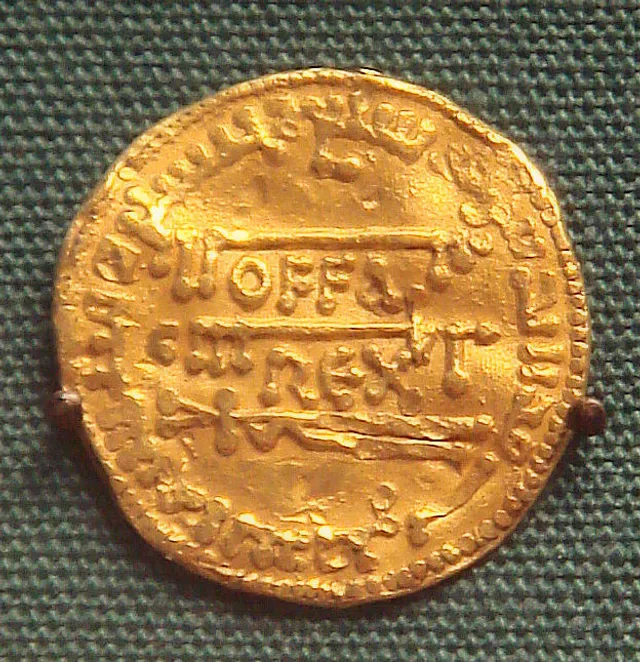
Why would a Christian English king strike a copy of an Islamic coin? Nobody knows for certain, and the Museum's account is deliberately careful. The leading suggestions are trade: Abbasid dinars were the prestige gold coin of the Mediterranean world, and a coin recognisable to Islamic merchants would be useful for payments in that world. Another strand connects it to Rome: Offa is recorded as having agreed a payment of gold to Pope Adrian I, and a "mancus", the word for such payments, shares its name with the gold coins of the period. It is tempting to read the dinar as a diplomatic or pilgrim-route coin, but the evidence does not settle the question, and it is honest to leave it open. Either way, the coin is proof that eighth-century England knew exactly what was circulating in Baghdad.
Three coins of the 770s
| Coin | Metal | Issuer and date |
|---|---|---|
| Sceat | Silver, often debased | Various Anglo-Saxon kingdoms, early 8th century, replaced through the 760s |
| Broad penny | Fine silver | First in Kent in the mid-760s (Heaberht), then Offa of Mercia; the model is Pepin's Frankish denier of c. 755 |
| Imitation dinar | Gold | Offa, c. 774 to 792, copying al-Mansur's dinar of 157 AH; one survivor, in the British Museum |
The penny's afterlife deserves a final sentence. From these Mercian experiments the design passed to Alfred the Great, to the Norman kings, to the medieval sterling, and effectively to every "penny" struck in Britain until 1971. When you hear that a decision cost a few pennies, you are using Offa's word for his new coin.
Sources & References
- British Museum object record 1913,1213.1: the gold imitation dinar of Offa
- British Museum object record 1915,0507.656: silver penny of Queen Cynethryth, moneyer Eoba
- D. M. Metcalf, "Betwixt sceattas and Offa's pence", British Numismatic Journal 79 (2009): the transition to the broad penny
- Marion Archibald, "A sceat of Offa of Mercia", British Numismatic Journal 74 (2004): Offa's early coinage and the Frankish context
- D. M. Metcalf, "Thrymsas and Sceattas in the Collection of the Ashmolean Museum" (1993–94): the standard reference on the earlier coinage
- Art of the Middle Ages: the Offa dinar: al-Mansur's dinar of 773/4 and the OFFA REX inscription
- Image: Offa gold dinar, Wikimedia Commons, public domain
- Image: Offa silver penny, Wikimedia Commons, public domain
The purpose of the gold dinar, the exact dating of the first broad pennies, and the reading of several garbled legends remain subjects of scholarly discussion, and this article presents them as unresolved. Reviewed against these records on 7 September 2026. If a date, figure, or interpretation needs correction, please contact hello@cointoss.uk.