
Why the Athenian owl tetradrachm kept its design almost unchanged for roughly three centuries, how the coin spread across the ancient economy, and what its imitations and test marks tell us about trust in ancient trade.
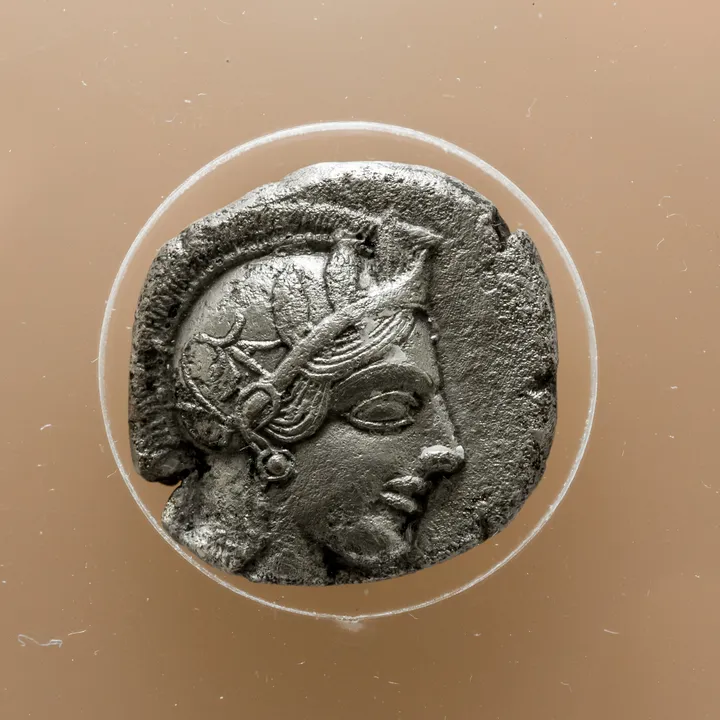
Athens redesigned its coinage once, around the end of the sixth century BC, and then apparently lost interest. The tetradrachm introduced in about 520 to 510 BC, a 17.2-gram coin of the Attic weight standard, kept the same archaic head of Athena and the same standing owl for something close to three hundred years, through wars, plagues, changes of constitution, and eventual incorporation into the Roman Empire. The Getty Museum's catalogue puts the run at "over four hundred years, beginning in the 510s BC", and the last New Style issues fall somewhere in the mid-first century BC. For comparison, think how long any design survives today.
The usual explanation, and I think the right one, is that the frozen design had become the point. Merchants from Massalia to Memphis could recognise an owl at a glance without weighing it or testing it, the way a modern driver reads a road sign. Athens was selling recognisability, and a redesign would have destroyed the asset.
Where the silver came from
Athens did not invent Greek coinage, and it came late to the tetradrachm. Its earlier "heraldic" coinages carried changing family devices, which suggests coins struck for local purposes rather than export. What changed everything was geography: the state-owned mines at Laurion, in south-east Attica, produced silver on a scale few Greek states could match.
The mines paid for more than coins. Herodotus records (7.144) that when a windfall from the mines was debated around 483 BC, Themistocles persuaded the Athenians to spend it on a fleet of two hundred ships instead of a cash handout. That fleet fought the Persians at Salamis three years later. It also gave Athens the navy that protected its grain route to the Black Sea, which the later empire was largely built around. The owl coinage and the Athenian empire are difficult to separate, and scholars such as John Kroll have traced how successive remintings, like the state reminting of Athenian silver in 353 BC, followed the city's fiscal needs.
A design you can read
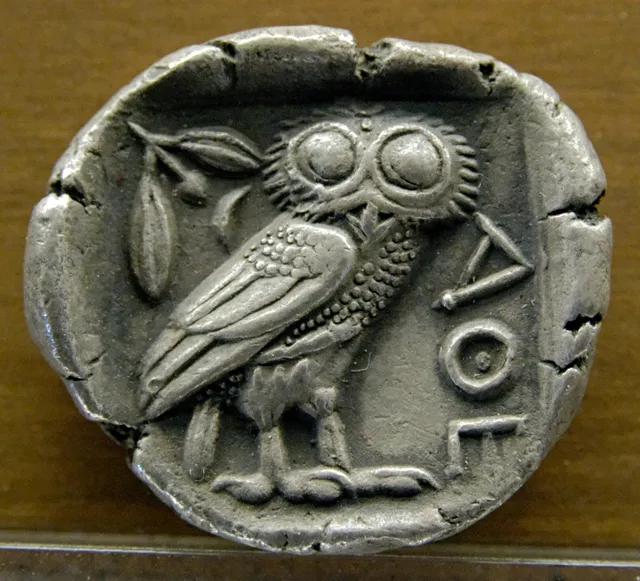
The coin's iconography is compact enough to unpack in a sentence or two per element. Athena, the city's patron goddess, wears a crested helmet decorated with olive leaves; the British Museum's object record for a tetradrachm (1947,0406.254) describes exactly this helmet with its olive wreath. The olive was Athena's gift to Athens in myth and its oil was a major export, so the tree on the helmet is also the product label. The reverse owl is her sacred bird, the little owl, Athene noctua, which still haunts the Acropolis rock. The sprig beside it repeats the olive. The letters ΑΘΕ abbreviate ΑΘΗΝΑΙΩΝ, "of the Athenians", which is as close to a trademark as the ancient world managed. The crescent moon appeared in the classical issues; some of the earliest owls lack it.
The trust problem, and how copies helped solve it
A coin is a promise that the metal matches the face, and the owl tetradrachm solved that promise better than any rival of its day. Its great competitor, the sea-turtle stater of Aegina, was also widely accepted, but the classic account by W. W. Tarn in the Cambridge Ancient History describes owls and tortoises as the two coins "welcome everywhere" in the Greek trading world. Athens' advantage was volume: with the Laurion supply behind it, the owl was simply present in enough quantity to become the default unit of account for long-distance trade.
What happened next is the most interesting part. Other states and traders copied the owl, sometimes badly, and the copies circulated alongside the originals. A study of a Near Eastern hoard published in the American Journal of Numismatics (2004–05) found that of more than 76 owls in the hoard, roughly 63% were genuine Athenian issues and around 37% were imitations, yet the imitations had clearly circulated at similar value. Distant mints in Arabia copied even the late New Style owls. A type gets copied when the type itself, rather than the issuing state, carries the trust. The design was the brand; anyone could see that an owl was an owl.
Trust did not mean blind trust. Many surviving owls carry test cuts or banker's marks, chops made by merchants to check the silver was real. If you look at an owl in a museum tray or an auction catalogue, the little gashes are worth hunting for: each one is a stranger from two and a half millennia ago doing the same thing a jeweller does today with a testing stone.
Three centuries, one table
Scholars debate the exact start date, with proposals ranging from about 525 to 510 BC (Kroll favours 520 to 510), and catalogues end the New Style series anywhere from 63/62 BC to around 42 BC. With that uncertainty stated, the arc looks like this:
| Period | What the coin did |
|---|---|
| c. 520–510 BC | First owls, after the heraldic coinages; 17.2 g Attic standard, archaic Athena and owl in an incuse square |
| c. 480–450 BC | Crescent moon and olive sprig become standard; Laurion silver funds the fleet of 483 and mass export begins |
| 454–413 BC | The classic mass-circulation owls, found in hoards as far away as Afghanistan |
| 393–c. 166 BC | Late Old Style issues with only stylistic drift; Athens remints its silver in 353 BC |
| c. 166/165 BC | New Style owls: a more naturalistic Athena, the owl on an amphora, magistrate names added |
| to mid-1st century BC | Production ends under Roman rule; catalogues give 63/62 BC or c. 42 BC |
Even the New Style "redesign" of the 160s BC stayed inside the template: same goddess, same owl, same letters, new details. After three centuries of refusing to change, Athens allowed itself a paragraph's worth of novelty.
Sources & References
- British Museum object record 1947,0406.254: Athenian tetradrachm
- Getty Museum, Coin (tetradrachm) of Athens: "minted for over four hundred years"
- Herodotus 7.144 (Perseus Digital Library): the Laurion silver and Themistocles' fleet, 483 BC
- John H. Kroll, "The Reminting of Athenian Silver Coinage, 353 BC", Hesperia 80 (2011)
- "A new Athenian 'owl' and bullion hoard from the Near East", American Journal of Numismatics 16/17 (2004–05): the 63% genuine / 37% imitation figures
- British Museum, "Luxury and Power" exhibition guide: Athenian silver and public spending
- Forum Ancient Coins NumisWiki: "New Style" tetradrachms
- CoinWeek, "The First Athenian Owls": earliest examples and the dating debate
- Image: Athens Agora tetradrachm, Wikimedia Commons, CC BY-SA 4.0
- Image: Lyon tetradrachm reverse, Wikimedia Commons, CC BY 2.5
Dating of the earliest owls and the end of the New Style series varies by scholar, and the figures quoted above are shown with their sources. Reviewed against these records on 7 September 2026. If a date, figure, or interpretation needs correction, please contact hello@cointoss.uk.